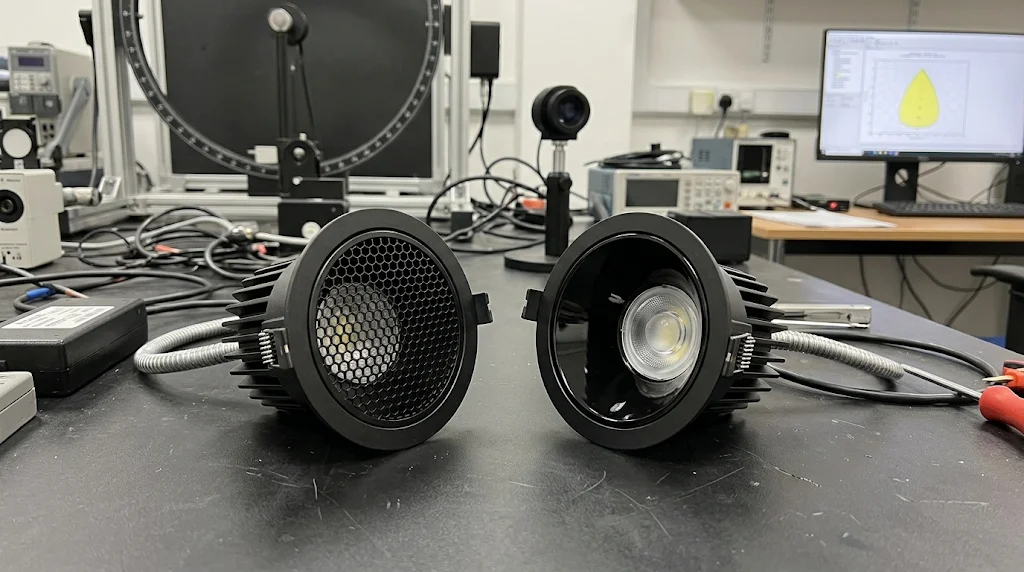
For commercial and hospitality LED downlights, visual-comfort criteria should be set for the actual task, room and applicable project requirements. A UGR limit is not universal; confirm it against the relevant standard and lighting brief. Honeycomb louvers are one optical option designers may consider.
A honeycomb louver can change beam distribution and luminous output because of its geometry. The effect depends on the luminaire, lens, cell design and fit. Compare it with other optical options using data for the actual configuration and the project calculation.
This technical guide explores the optical mechanics behind honeycomb louvers and black reflectors, highlighting the project considerations for choosing the right anti-glare solution for LED downlights.
1. Honeycomb louver: limiting high-angle light
A honeycomb louver is one option for limiting some high-angle light in settings such as museums, galleries and retail displays. Its grid can block some rays; the resulting distribution depends on cell depth and opening, luminaire geometry and viewing position.
The grid may limit direct view of the light source from some angles. Perceived glare also depends on source luminance, room surfaces, layout and observer position, so the accessory alone does not determine the result.
Any change in total luminous flux should be checked for the exact luminaire and louver using comparable photometric data. No measured comparison is provided here, so a universal or percentage light-loss claim would not be justified.
For projects with many luminaires, use photometric data for the selected configuration in DIALux or RELUX. Adjust product selection or layout according to the calculated illuminance; do not assume a higher wattage is automatically required.
2. Deep-recessed black reflector: another optical approach
If the design objective is to minimize glare in general ambient spaces without sacrificing too much optical efficiency, blocking the beam physically isn't the only solution.
A deep-recessed dark reflector is another optical approach. Recess depth, geometry and finish can affect source visibility and light distribution at different viewing angles. A dark or glossy appearance alone does not establish how much light a surface absorbs or redirects.
There is no universal efficiency ranking between a honeycomb louver and a black reflector. Compare photometric files for the same luminaire and optical configuration before drawing conclusions about luminous flux or efficacy.
3. UGR and project application
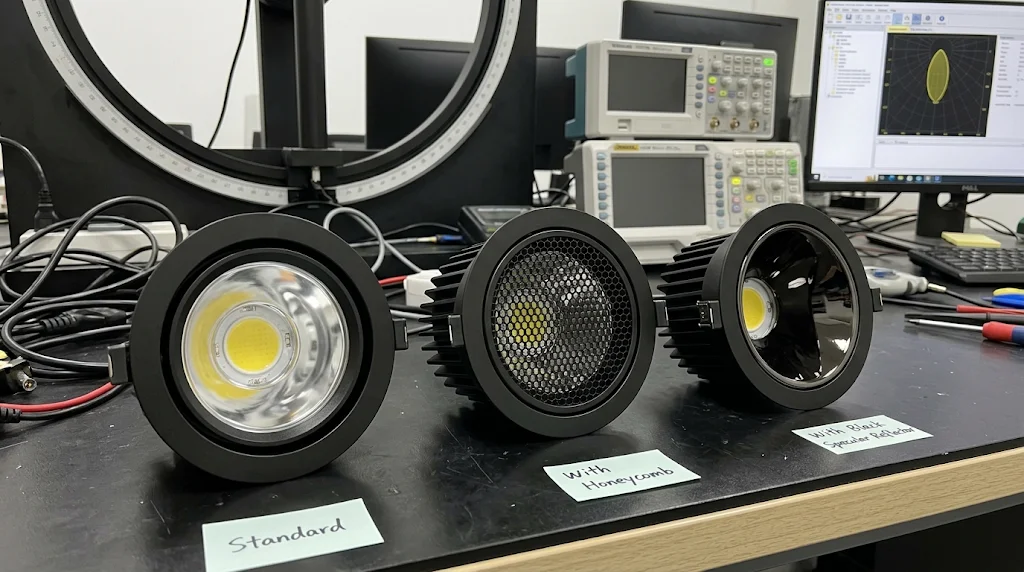
UGR is not a fixed property of a luminaire. It is calculated from factors including room dimensions, surface reflectances, luminaire position and observer location. Optical accessories may influence the distribution, but the complete room design determines the calculated result.
Applicable standards set criteria according to the visual task and space. Confirm the required values from the current standard and project brief, then assess the complete layout in a lighting calculation. Neither a louver nor a reflector alone establishes compliance or a universally best balance.
| Optical configuration | What to verify | Project consideration |
|---|---|---|
| Lens without accessory | Reference configuration; confirm output in product data. | General lighting when its distribution meets the project criteria. |
| Honeycomb louver | May change flux and distribution; check matching photometry. | Consider when limiting some high-angle light is part of the brief. |
| Deep black reflector | Depends on geometry, material and finish; check matching photometry. | Consider when recess depth or source visibility matters to the design. |
IES Files and Lighting Calculations
Before finalizing a design, use an IES/LDT file that matches the selected luminaire and exact optical configuration in DIALux or RELUX. If matching data is unavailable, request confirmation rather than assuming another configuration is equivalent.
Photometric-file availability depends on the product and its exact configuration. Contact FANXING LIGHTING to confirm whether current IES/LDT data is available for the selected model and optical option.
Contact our engineering team to request available technical documentation or discuss the optical configuration for your OEM lighting project.
WhatsApp: +86 187 1157 1112 │ Email: [email protected]