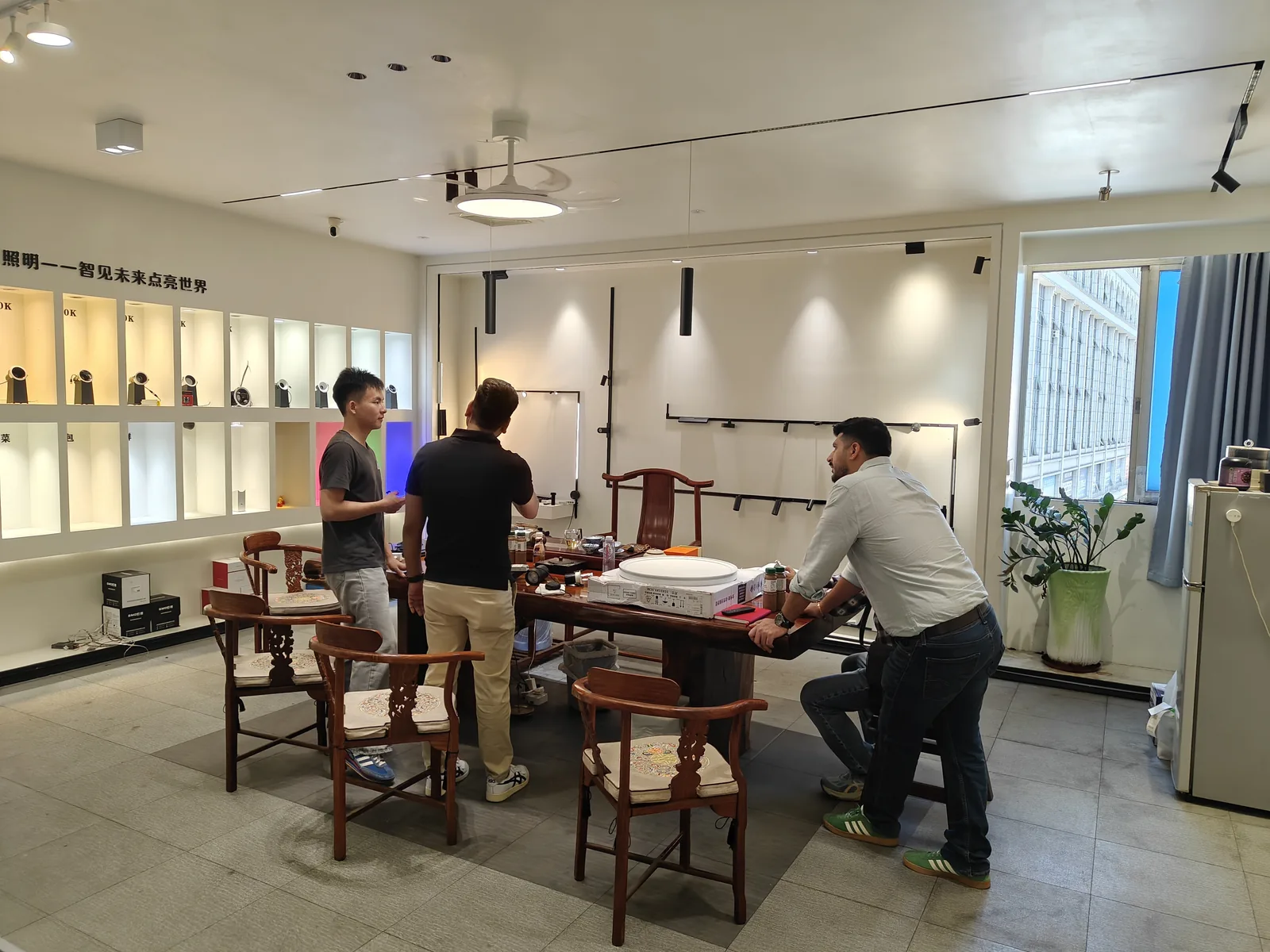
In March 2026, we welcomed Dutch customer Lucas and the lighting brand’s quality team for a visit to Zhongshan, Guangdong. They travelled from Amsterdam and this was the fifth factory on their Guzhen-area itinerary.
Selling lighting into the EU means CE, RoHS, and Ecodesign paperwork. The paperwork is the easy part. What fails is the LED driver that ships in volume, which often isn't the one that went to the lab. Lucas told us their previous supplier cut corners on power supplies; a batch of indoor downlights failed radiated emission tests during a market surveillance check, and the shipment was rejected.
This time, they brought 3D drawings of three commercial and decorative fixtures. Their requirement: find an OEM lighting manufacturer that understands structural optimization and actually controls the shop floor to mitigate EU compliance risks. Here is what we discussed during the 4-hour factory audit.
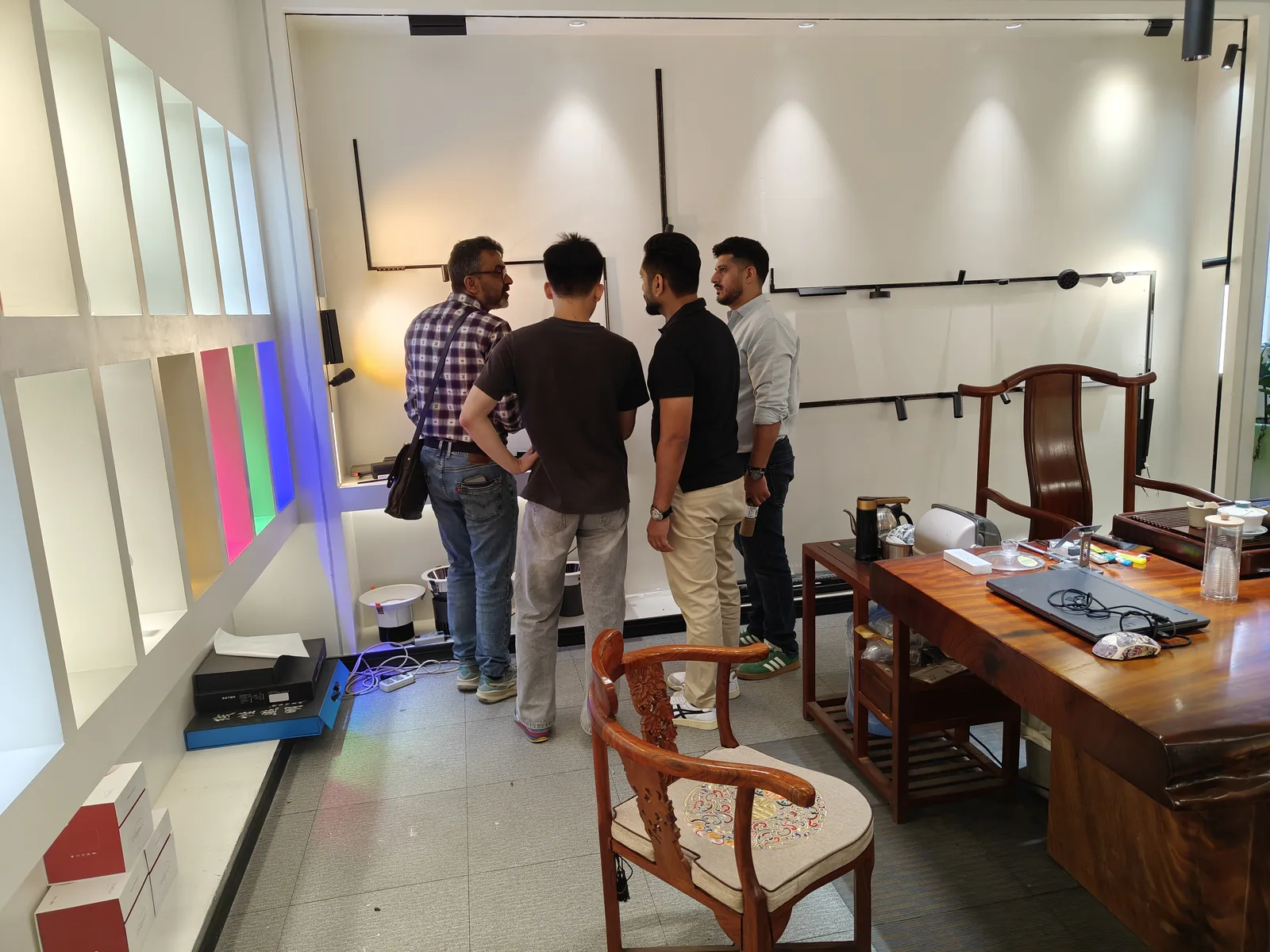
Optical Testing: Hitting European Light Quality Targets
European buyers are particular about light quality. Lucas presented a current best-selling sample: “We need the 3000K light colour of our new products to match this exactly. No greenish or pinkish tints.”
We took the team to the optical lab, powered on the sample and placed it inside our 1.5-metre integrating sphere. The case report recorded SDCM 3.2 for the 3000 K sample, CRI Ra 95.2 and R9 72. The quality team noticed the colour shift on the screen.
We explained that mass production could be held within 2.5 SDCM steps of the approved sample, but only if we restrict the Citizen or Bridgelux bin and account for the colour shift the optic adds.
To ensure this consistency on the floor, we agreed that upon the arrival of the LED chips, our Incoming Quality Control (IQC) executes sampling based on the AQL 1.5 standard. The spectral test reports are then sent directly to Amsterdam with the packing list, replacing visual checks with hard machine data.
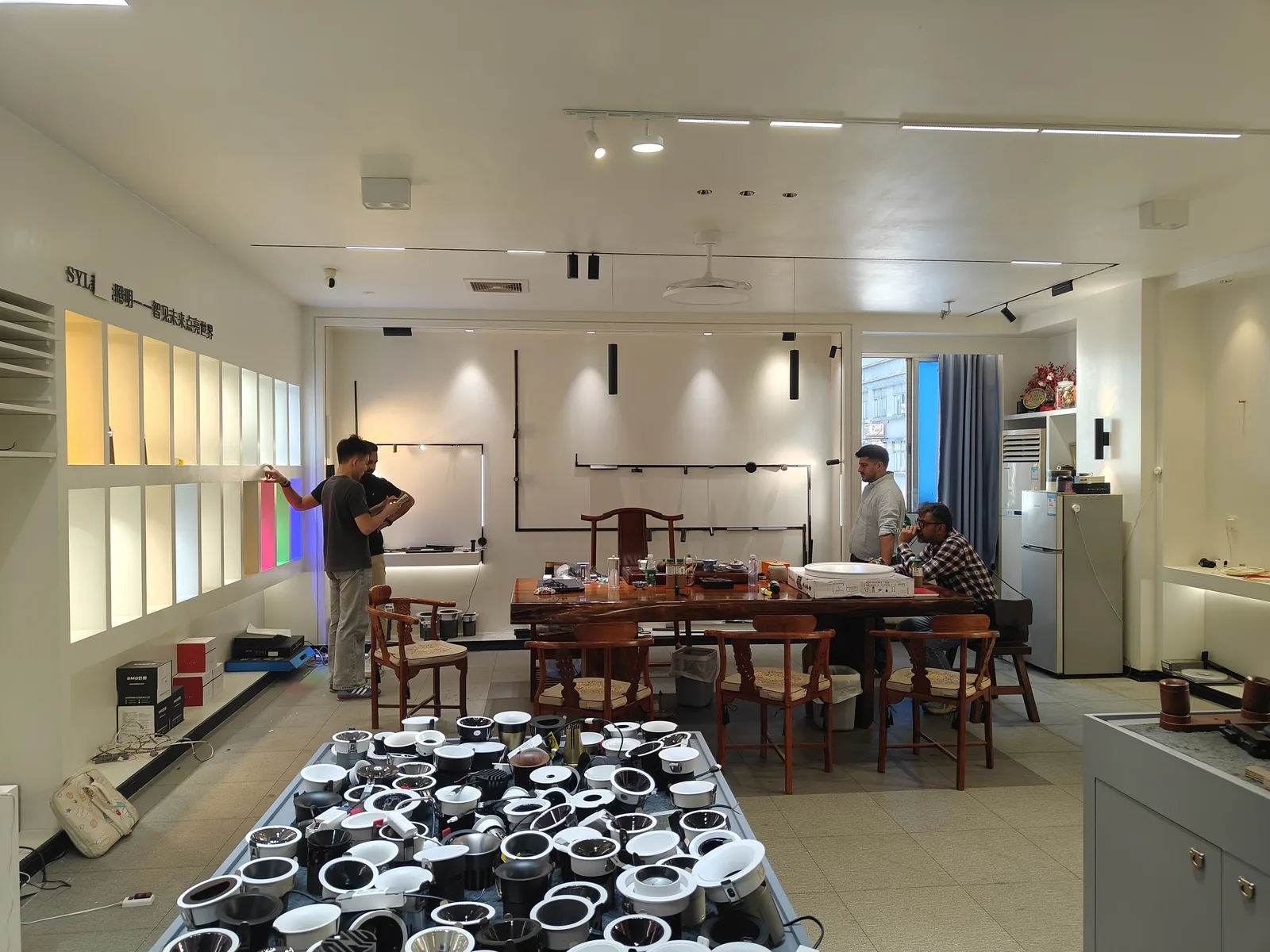
On the Line: Avoiding CE (LVD/EMC) Non-Compliance
As we walked past the assembly line, the QA engineer stopped. Power supply compliance was a priority.
“Many factories send good drivers to the lab for CE, but swap them for cheap drivers without EMC filter circuits in mass production. How do we prevent this?”
We asked the line supervisor to open a driver box from a commercial downlight currently being assembled. Pointing to the PCB, we showed them our baseline:
The driver discussion covered input X-capacitors and common-mode chokes for conducted interference, EN IEC 55015 and, where applicable, harmonic-current requirements under EN 61000-3-2. Driver selection and the complete luminaire’s test results need to be assessed together.
For the Class II design discussed, the team reviewed reinforced insulation and a primary-to-secondary creepage distance of at least 5.0 mm. The appropriate clearance, creepage and safety assessment depend on the actual design and applicable EN 60598-1 requirements.
We also pulled up our data packs for EPREL registration (Regulation (EU) 2019/2015) and REACH declarations, along with the product data needed for WEEE registration, showing how we support clients with the necessary documentation.
| Core Pain Points of EU Buyers | How We Control It | Outcome for the Brand |
|---|---|---|
| Batch-to-batch colour shifts | Lock specific Bin codes in BOM; AQL 1.5 integrating sphere sampling. | Target of ≤ 2.5 SDCM relative to the approved sample. |
| CE-EMC / Ecodesign failures | Select drivers and verify the complete luminaire against applicable EMC and ecodesign requirements. | Supports project-level EMC and applicable ecodesign verification. |
| Non-compliant RoHS materials | Verify SGS material reports upon intake; reject inferior hardware. | Supports material traceability and REACH/WEEE data preparation. |
Tooling Costs: Dropping a Mold Fee to Zero
Reviewing 3D drawings in the office, Lucas’s team presented a minimalist linear pendant light. Their European design agency suggested opening an aluminium die-casting mould for the whole body. With an initial order of only 600 pieces, a $4,000+ USD tooling fee was a hard sell.
After checking the CAD files, our structural engineer provided an alternative:
“You don’t need the die-cast tool. We already have the 6063 extruded channel. We can CNC-machine the end caps from solid bar, and powder-coat everything in fine-texture black. Gaps stay under 0.2 mm, heat dissipation is fine, and tooling is zero.”
Lucas was initially skeptical about the machined end caps matching the extruded body. We brought a raw machined sample from the workshop; after reviewing the fit, Lucas approved the change.
How to Spot a True Manufacturer
At the end of the audit, Lucas shared the team’s experience in Guzhen. To evaluate whether a company is a manufacturer, the team focuses on three indicators:
Test Report Headers
They request in-house IES reports or safety test sheets to verify if the applicant's name matches the factory's business license.
The Lab
Trading companies often just have showrooms, while a real factory is equipped with loaded Aging Racks, Hi-Pot testers, and integrating spheres.
SOPs
They review the assembly line to see if there are actual Standard Operating Procedures for the specific models hanging above the workstations.
The Outcome: From Audit to First Container
Ten days after the audit, we shipped the first CNC-machined physical prototype to Amsterdam. The sample passed LVD, EMC, and ErP pre-testing at a local Netherlands lab (reports available on request). The initial mass production order of 600 units shipped at the end of May.
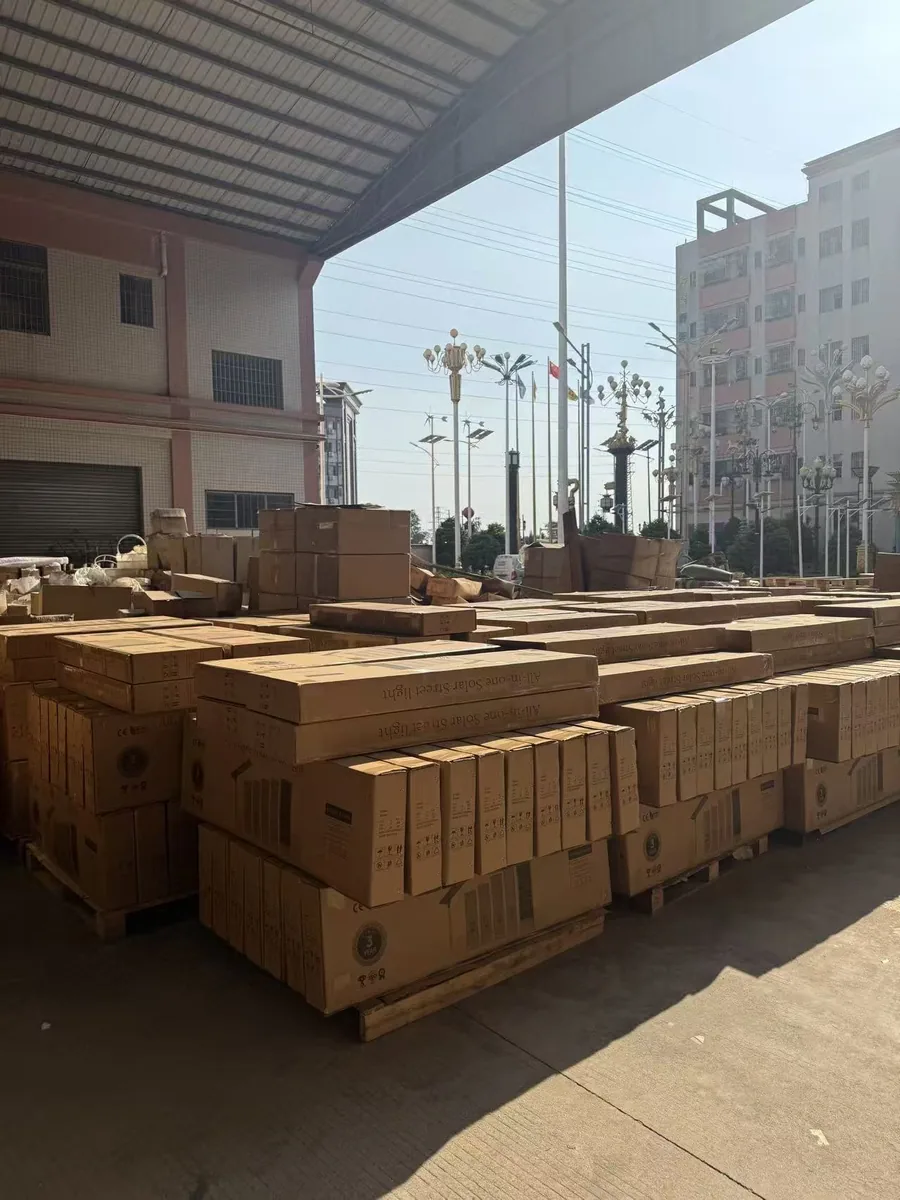
Planning to Move Your Lighting Production to Zhongshan, China?
We invite global lighting brands and importers to visit Fanxing Lighting's manufacturing base in Guzhen. Whether you need a video audit or have new product drawings:
- Receive a DFM (Design for Manufacturability) assessment within 48 hours.
- Get access to integrating sphere data, Hi-Pot testing, thermal aging, and salt spray records.