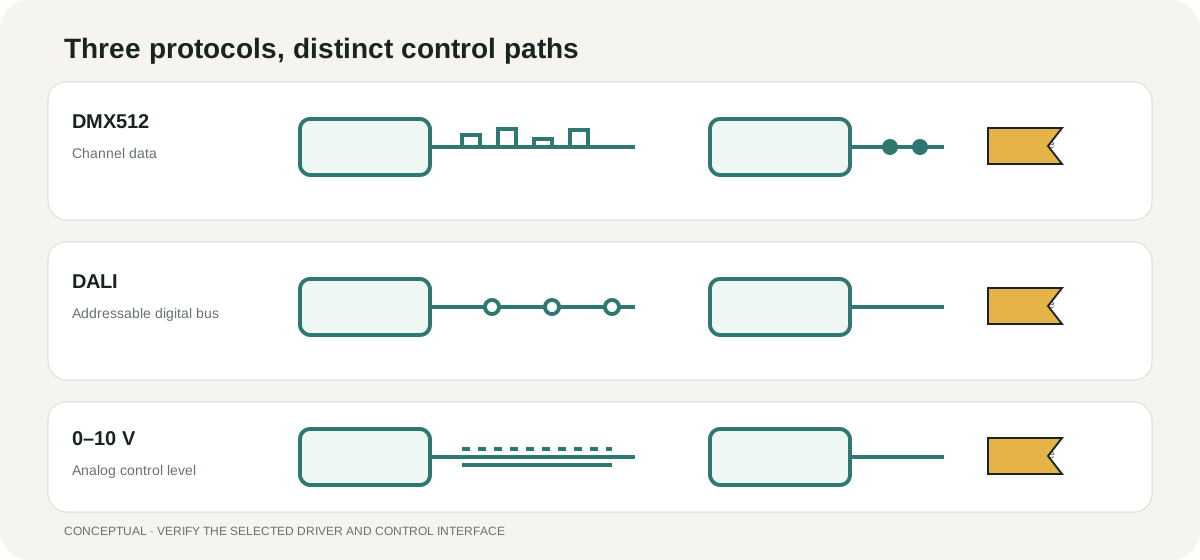
A hotel may need quiet, independently adjustable guest-room scenes and a separate RGBW show on its facade. Those are different control jobs, even when both are described as lighting control. DMX512, DALI and 0–10V are not interchangeable protocols. The right choice depends on the required behavior, the control gear installed in each luminaire, wiring and commissioning responsibilities, and how the system will be maintained.
This guide compares the three approaches for project specification and procurement. Treat the recommendations as starting points: the selected controller, LED driver, decoder, luminaire and local installation rules determine what will work in a real project.
Quick Answer: Which Lighting Control System Should You Choose?
- DMX512 is often a good fit for coordinated, rapidly changing color or intensity across RGB/RGBW fixtures, including facade and entertainment applications. Device feedback requires equipment and a bidirectional method such as RDM; it is not a property of basic DMX512 alone.
- DALI or DALI-2 is often suitable for building lighting that benefits from individual addressing, groups, scenes, commissioning and supported device feedback. Check the certification and functions of every relevant control gear and control device.
- 0–10V can suit straightforward zone dimming where the chosen controller and LED drivers have a matching analog interface. Confirm the dimming curve, minimum level, source/sink behavior and whether a separate switching device is needed to turn the load fully off.
A project may use more than one protocol, joined by a deliberately specified controller or gateway. Select from the required operation and verified device compatibility, not from the protocol name alone.
DMX512 vs. DALI vs. 0–10V: Comparison Table
| Procurement question | DMX512 | DALI / DALI-2 | 0–10V |
|---|---|---|---|
| Control method | Repeated digital channel values | Addressable digital commands | Analog control voltage |
| Signal type | Serial data on a balanced RS-485-based physical layer | Two-wire digital bus; bus power and devices follow system design | Low-voltage analog control pair |
| Typical applications | Dynamic scenes, RGB/RGBW, facade and entertainment lighting | Addressable building lighting, room and floor scenes, managed commercial spaces | Simple dimming by circuit or zone |
| Individual addressing | Start address and fixture personality determine slots used | Individual addresses, groups and scenes are configured during commissioning | Usually shared circuit or zone; no native luminaire addressing |
| Group / zone control | Controller groups channels or fixtures in its show logic | Groups and scenes are defined in the system | Set by the control circuit and wiring |
| Dynamic color control | Common when fixture and controller personalities support it | Possible with compatible color-control gear and system functions, such as supported DT8 use | Not inherent; additional compatible channels or controls are needed |
| Feedback | Basic DMX512 is unidirectional; RDM-capable equipment can provide supported feedback | Queries and feedback depend on compliant gear, devices and controller support | No native digital device status feedback |
| Wiring considerations | Data topology, cable, polarity, termination and splitter design matter | Bus topology, bus supply, addressing and device limits must follow system documentation | Control-pair polarity, cable and controller/driver interface matter |
| Commissioning | Patch, channel mode, start addresses and scene programming | Address discovery, grouping, scene programming and control-device setup | Zone assignment, output range and dimming performance |
| Driver / decoder compatibility | Fixture may include a compatible receiver or need a suitable decoder and driver | Control gear must implement the required DALI functions | Driver and control must match the analog interface and electrical behavior |
| Expansion | Capacity is expressed in universes and used channel slots; network architecture may be needed | Plan bus capacity and controller architecture from verified system limits | Expansion may require more control circuits and switching |
| Maintenance | Replace or readdress devices; RDM can help only where supported | Query supported status and recommission after device changes | Fault isolation is often by zone and electrical checks |
| Relative complexity | Moderate to high when many universes, effects or distributed lines are involved | Moderate; grows with device functions, integration and commissioning scope | Often simple at small scale; wiring grows with zones and features |
The table is a project-level comparison, not a promise that products carrying a protocol label have identical behavior. Ask for the exact driver or decoder model, control interface, channel mode and commissioning documents.
What Is DMX512 Lighting Control?
DMX512-A is the digital data-transmission method described by ANSI E1.11 for controlling lighting equipment and accessories. A DMX Universe commonly means one DMX data link carrying up to 512 data slots after the start code. A slot carries a value for a control channel; it does not equal one fixture. A fixture using several channels consumes several slots, so the number of controllable fixtures depends on each fixture’s mode. ESTA’s ANSI E1.11-2024 standard listing identifies its purpose as digital data transmission for controlling lighting equipment and accessories.
A DMX Controller sends channel values over the data line. A luminaire may contain a receiver, or a DMX Decoder may translate the data into outputs used by a compatible driver and LED load. RGB commonly uses separate red, green and blue channels; RGBW adds a white channel when the selected fixture personality supports it. The controller’s patch and the luminaire’s documented channel mode must agree. For an end-to-end setup example, see the DMX512 wiring and addressing guide.
DMX is useful for Dynamic Lighting Scenes because a controller can update many channels together. Multiple universes may be distributed over a suitable network, but the network transport does not change the fixture’s underlying DMX personality or remove the need to plan the data path.
DMX data is not fixture power. Each luminaire still needs a correctly specified supply and driver. Treat the DMX data chain, power distribution and protective design as separate parts of the approved installation. A DMX Splitter or optically isolated distribution device can be appropriate when a system design requires branches, isolation or additional line loading capacity; use equipment documented for the selected protocol and topology rather than making a passive star connection.
Signal Termination is part of data-line design. A compatible 120-ohm Terminator is normally installed at the physical end of a DMX data run as specified by the network equipment and installation design. Cable type, connectors, polarity, run layout and splitter ports all affect signal integrity. The ESTA DMX512 published-document list also lists ANSI E1.20 for RDM (Remote Device Management). RDM is a separate bidirectional standard that operates over a compatible DMX512 link and can support discovery, remote configuration and status reporting. A basic DMX512 Controller and receiver do not automatically have RDM feedback.
What Is DALI and DALI-2 Lighting Control?
DALI means Digital Addressable Lighting Interface, a digital lighting-control protocol specified in the multi-part international IEC 62386 standard. On a DALI Bus, compatible control gear can receive addressed commands as well as broadcast commands. A commissioned system can assign individual addresses, arrange gear into groups and store scenes, allowing spaces to be reconfigured in software rather than by rewiring every zone. The DALI Alliance’s IEC 62386 overview describes the standard’s parts and status. DALI Power Supply provides bus power; it is separate from the luminaires’ mains supply and must match the documented system design.
DALI-2 Certification is a certification program maintained by the DALI Alliance and based on the latest DALI protocol. It includes tested product types such as control gear and control devices. It does not follow that every product advertised as DALI-compatible is DALI-2 certified. Check the exact model and the DALI Alliance product listing. The Alliance’s DALI versus DALI-2 comparison explains the certification and interoperability distinction.
A system may include an Application Controller, which decides what commands to send, and Input Devices, such as sensors or user interfaces, that provide events or user input. Addressable Control Gear operates the light source and responds to supported commands. These roles and their certification are not interchangeable; see the DALI Alliance’s explanation of control devices.
DALI supports bidirectional communication, but actual Device Feedback depends on the gear, device type, standard part, controller and software. A system can query supported state or faults; do not assume every luminaire exposes every diagnostic. Commissioning is therefore essential: discover devices, resolve addresses, configure groups and scenes, and test inputs, control gear and any gateways as a connected system. DALI can support tunable white or color-control functions where the necessary gear and control functions are implemented; DT8 refers to standardized color-control gear functions, not a guarantee that any DALI luminaire has them. The Alliance’s DALI introduction describes individual control, groups and two-way communication.
What Is 0–10V LED Dimming?
A 0–10V Dimming Interface uses an analog voltage on a control pair to request a light level from a compatible LED Driver. It is often selected for simple office, linear-lighting or downlight zones where the owner needs a shared dimming level rather than individually addressable luminaires. The control signal is distinct from the driver’s mains input and LED output.
The label does not guarantee one universal implementation. Source / Sink Compatibility describes which device provides or absorbs the small signal current; the control and driver must form a compatible pair. Dimming curve, control current, wiring polarity, minimum dimming level and response to an open or unpowered control line can also vary. Lutron’s technical note on 0–10V control topology explains why control and driver specifications must be checked together.
The ANSI C137.1 0–10V interface scope sets requirements for dimmable drivers and control units; NEMA’s ANSI C137.1-2022 scope document states that PWM control is outside that standard. PWM changes output by pulse-width modulation and is not the same electrical interface as an analog 0–10V input.
Do not promise that setting a 0–10V signal to its minimum will always switch the luminaire fully off. Some drivers dim to a specified minimum and need separate switching for off; other products document dim-to-off behavior. 1–10V vs. 0–10V labels may refer to different conventions or implementations, so compare the actual driver and controller data sheets rather than inferring behavior from a label. Confirm the Dimming Curve, minimum level, dim-to-off behavior, switching method, input current and whether the control is designed to source or sink current. Under IEC 60929, a 1–10V implementation typically reaches minimum light output at 1 V or below; this does not itself command off. “0–10V” is also used across different source/sink and driver/control implementations, so the label alone does not define low-end behavior. See Lutron’s explanation of 0–10V control topology and confirm both paired data sheets.
Wiring and Installation: What Changes Between the Three Systems?
- DMX512: Plan a data daisy chain, fixture addressing and channel modes. Use suitable cable and compatible connectors; keep polarity consistent, place signal termination at the designed end of the link and use a documented splitter or isolation device where the topology calls for it. A splitter redistributes data; it does not create additional channel slots in the universe.
- DALI: Design the DALI Bus and bus supply for the selected gear and control devices. Follow the system documentation for conductor arrangement, bus capacity, topology and cable limits. Addressing, groups, scenes and controller/input-device relationships are part of commissioning, not merely wiring.
- 0–10V: Treat the Control Pair as an analog interface. Check polarity, signal current, source/sink compatibility, supported cable route and whether switching is separate. Measure or mock up dimming performance with the actual control and drivers when smooth low-end dimming is important.
No controller pinout, conductor color or wiring separation rule is universal. The installation must follow the selected manufacturer’s documents and local electrical code. Qualified personnel should design mains wiring, protective measures and any separation between line-voltage and low-voltage circuits. Do not connect a control output to a driver unless both documents specify the interface.
Which System Is Best for Different Lighting Projects?
1. Hotel Guest Rooms
Typical requirements: local room control, a few scenes, occupancy inputs, quiet operation, and coordination with room-management systems. Approach: DALI may be appropriate for addressable drivers and configurable groups; a compatible room controller or gateway may coordinate other systems. A simpler zone-based control can be suitable where the brief does not need individual addressing. Why it may fit: DALI scenes and addressing can support room reconfiguration and centralized management. Verify before procurement: driver certification and functions, wall-station and sensor compatibility, integration boundaries, emergency-lighting requirements, dimming range and who commissions the room. For room-planning context, see hotel lighting solutions.
2. Office Buildings
Typical requirements: work-area zones, daylight or occupancy inputs, schedules, scene control and changes to partitions or tenant layouts. Approach: DALI is often a candidate where addressable gear and reconfigurable groups are useful. 0–10V can work for simpler fixed zones with a verified control/driver match. Why it may fit: the best balance depends on how much zoning and future reconfiguration the operator needs. Verify before procurement: number of circuits or addressable devices, control-system integration, low-end dimming behavior, sensor inputs, bus or control-line capacity and commissioning ownership. For compatible luminaire categories, see commercial downlights.
3. RGBW Building Facades
Typical requirements: coordinated color, intensity and time-based scenes, plus a defined method to address and service each luminaire. Approach: DMX512 is often considered when the selected facade fixtures or decoders expose compatible DMX personalities. Why it may fit: channel-based control supports coordinated RGB/RGBW changes across many fixtures. Verify before procurement: channel mode, channel count, controller output, universe and network plan, RDM support if desired, driver/decoder arrangement, data termination, weather protection and nighttime aiming. For the optical question, compare wall washing and wall grazing lighting. For relevant outdoor products, see outdoor wall washers.
4. Restaurants and Hospitality Spaces
Typical requirements: a small set of scenes, separate dining and service zones, warm or tunable white options, and easy staff operation. Approach: DALI, 0–10V, or a mixed solution may fit depending on luminaire drivers, room controls and how scenes are managed. DMX may be reasonable for a venue that needs coordinated dynamic effects. Why it may fit: the space’s operational needs matter more than the venue label. Verify before procurement: scene controller, supported white/color functions, after-hours operation, staff interface, compatibility across fixture families and service access.
5. Outdoor Architectural Lighting
Typical requirements: control of facade, landscape or wall-washer layers, scene schedules, environmental protection and maintainable data distribution. Approach: DMX512 can suit dynamic effects; DALI or 0–10V may be better for static or zoned operation where the chosen outdoor gear supports it. A gateway can bridge systems if its functions and failure behavior are specified. Why it may fit: outdoor projects vary widely in whether they need per-fixture effects, building-wide scenes or only scheduled zones. Verify before procurement: actual protocol on each driver, outdoor ratings of the complete installation, cable route and network design, light spill, maintenance access and local restrictions. A hybrid control design should be tested as a system.
Common Mistakes When Choosing a Lighting Control System
- Selecting a controller before confirming the LED Driver or decoder model.
- Treating DMX512 and DALI as interchangeable because both use digital control.
- Assuming a DMX receiver supports RDM, or that every DALI device reports detailed faults.
- Describing a compatible DALI product as DALI-2 certified without checking the certification listing.
- Assuming every 0–10V driver can dim to zero or switch itself off.
- Ignoring sink/source behavior, driver input current, polarity or dimming curve.
- Counting fixtures instead of DMX channel slots, or overlooking the chosen RGBW personality.
- Treating a DMX splitter as extra universe capacity.
- Assuming all 48V magnetic track systems support a particular protocol. Supply voltage and dimming protocol are separate decisions; see the 48V magnetic track lighting system guide.
- Leaving network commissioning, control integration and future service responsibility unassigned.
What Should Buyers Confirm Before Ordering?
Prepare a fixture schedule and confirm, for every configuration: luminaire type; required wattage and input voltage; exact LED Driver or DMX Decoder model; supported dimming protocol; dimming range and curve; RGB/RGBW or tunable-white channels; controller compatibility; address or zone plan; fixture quantity; indoor/outdoor environment and required IP rating; wiring diagram; commissioning responsibility; sample or mock-up testing; and applicable certification documents. Confirm whether the requested data, driver and control equipment are included, supplied separately or provided by another contractor. Do not infer protocol support from a product family name.
For magnetic-track applications, also distinguish track supply and mechanical compatibility from the luminaire’s driver and control input. A 48V system is not automatically DALI, DMX512 or 0–10V compatible.
How FANXING LIGHTING Supports Custom Lighting Projects
FANXING LIGHTING manufactures decorative, commercial and outdoor lighting and supports OEM/ODM and project-based product selection. For a custom architectural or commercial lighting request, the useful starting point is a fixture schedule, drawings, application conditions, target effects and the control-system brief. The team can review the requested driver and control interfaces with the buyer and communicate which configuration details need confirmation with the selected component documentation. Protocol support is product- and driver-configuration-specific; it should be confirmed for the exact model before specification or order. FANXING does not claim that every product supports DMX512, DALI or 0–10V, and this guide does not represent certification of a FANXING product. To discuss drawings, samples or interface requirements, contact FANXING LIGHTING or send a project inquiry.
Frequently Asked Questions
Is DMX512 better than DALI for architectural lighting?
Not in every case. DMX512 can suit dynamic, channel-based color effects; DALI may suit individually addressable building lighting, scenes and supported status queries. Choose from the required behavior and compatible control gear.
Can DALI control RGBW lights?
A DALI system can control color-capable gear when the required functions, such as suitable DT8 color control, are implemented by the gear and supported by the controller. Confirm the exact driver and control implementation; the DALI label alone does not establish RGBW capability.
Can a 0–10V LED driver work with a DALI controller?
Not by connecting a DALI bus directly to a 0–10V input. A correctly specified gateway or interface may translate between systems, but it must support the driver’s analog behavior and the DALI system’s required functions.
What is the difference between DALI and DALI-2?
DALI is the protocol specified through IEC 62386. DALI-2 is the DALI Alliance certification program based on later protocol parts and including tested control-device types. Verify certification for the exact product.
Is DMX512 suitable for hotel lighting?
It can be suitable for a hotel application that needs coordinated dynamic effects, such as a facade or entertainment area. Guest-room control may need different functions such as scenes, local inputs and management integration. One hotel may use more than one system.
Does 0–10V dimming always turn LEDs completely off?
No. The minimum signal may correspond to a minimum light level, and behavior varies by driver and control. Confirm the specified minimum and whether separate switching or documented dim-to-off is required.
Can different lighting control protocols be used in one project?
Yes, when controllers or gateways are designed to connect them and the interfaces, scenes, status behavior, failure modes and commissioning are tested together. Protocols are not directly interchangeable at a wire connection.
Technical References
- ESTA published standards: ANSI E1.11-2024 and ANSI E1.20 RDM
- DALI Alliance: IEC 62386 standard overview
- DALI Alliance: DALI-2 compared with DALI version-1
- DALI Alliance: Introducing DALI
- DALI Alliance: Control devices
- NEMA: ANSI C137.1-2022 scope and contents
- Lutron: 0–10V control topology and source/sink compatibility
Discuss Your Lighting Control Requirements
Share the project type, luminaire schedule, drawings, required scenes and the LED Driver or decoder details through FANXING LIGHTING’s project inquiry. This helps the team review the requested configuration without assuming protocol support that has not been confirmed.